

I’ve always been looking for my thing.
The work that made sense.
The work that fit.
For a long time, I thought that meant purposeful, world-changing work. Something noble. Something impressive. But over time I’ve realised it’s simpler (and harder) than that. What I was really looking for was work that suited me. Work that felt like an extension of who I am, rather than a role I had to perform.
When I was a teenager, I knew instinctively that my work had to also be my hobby. What I meant by that wasn’t that I wanted to mess about all day, but that I wanted to do something I’d still choose even if I wasn’t paid. Energy mattered more to me than status. Aliveness mattered more than income.
The story I inherited
The story I inherited was that the right job was the one that paid the most money. That income was the clearest measure of success. That definition of success initially derailed me.
And then quietly disoriented me for a couple of decades.
I was torn between needing a job that paid and longing for work that felt right. The problem was, I didn’t have a compass. No guidance. No language for what I was actually searching for. So for a long while, I felt like I was wandering in the wilderness — emotionally, more than professionally. I did things. I achieved things. But none of it truly lit me up.
That wilderness eventually led me to working with Laurence, and to starting two businesses together. The first was our digital agency, Spook Studio. The second was The Happy Startup School.
For a while, we ran both. On paper, it made sense. In reality, it didn’t. I had no excitement or energy to grow the agency on my own, and Laurence was fully committed to The Happy Startup School. Eventually, the truth became unavoidable: I could no longer play the role of the digital professional. It just didn’t fit anymore. And if I’m honest, I’m not sure it ever really did.
And yet, even starting The Happy Startup School didn’t immediately feel like my work to do.
I was still holding onto the identity of the coder, the tech person, the digital guy. I couldn’t quite reconcile that with retreats in nature and running a festival in a field. I went through a proper dark night of the soul trying to work out what I should be doing and being relentlessly self-critical about not having found “my thing” yet.
What I was really trying to do was squeeze an old version of myself into a new reality. And it wasn’t working. It didn’t feel good at all.
Stripping things back
So I had to strip things back. Slowly. Painfully.
I had to get underneath the roles and identities and start paying attention to what actually drove me. To my needs. To the old scripts that were still running in the background. To what success really meant to me, rather than what I’d been told it was meant to look like.
That required letting go of a lot. And the uncomfortable part was that I didn’t know what I was letting it go for. It took nearly eight years to find it. And where I ended up wasn’t something I’d planned or even imagined. But it feels completely right.
What I do now makes sense both in terms of what I offer and in terms of why I’m the one offering it.
I help people slow down enough to hear what’s already there — and then support them with the structure and courage needed to turn that clarity into work that feels alive, sustainable, and true to who they are.
It’s my work to do because it’s been my journey.
Building a business and making a living
So what does this mean for building a business or making a living?
It’s meant finding a different way.
I don’t believe in hierarchies. They put me off. I’m wary of them. What I crave is connection and relationships that energise and expand me. Traditional ways of working, especially in large organisations, never really aligned with that.
To build a business that felt like me, I’ve had to learn a lot about myself. About conflict. Boundaries. Needs. Wants. Limits. It’s been an inside-out journey that I’ve taken at the same time as building a business. It’s not the most efficient route, but it’s taught me more than any shortcut ever could.
I’ve lived this journey, not just learned it.
At its heart, this work is about people. And that’s where it’s been hardest as I’ve had to change. I’ve had to learn about my responsibilities in conflict. Because when you know what you want, you have to be willing to stand up for it.
That fight has been both internal and external. It’s been a fight against my own patterns and against the status quo of how business is usually done. And one of the most important things I’ve learned is not to do it alone.
Laurence and I were friends long before we were co-founders. That matters. It’s shaped how we work, how we disagree, and how we stay in relationship when things are difficult. I think it’s a big part of why we’re still here and why we do business the way we do.
It’s a human-first approach.
It asks for bravery, honesty, vulnerability, and compassion.
It’s about relationships that are holistic, not transactional.
I genuinely see my customers, coaches, mentors, suppliers, and collaborators as friends. Being part of a community is what makes this way of working feel right. I now believe it’s more important to move together than to move fast.
When we’re truly connected, work starts to feel like play.
Sometimes it feels like art.
Sometimes it just feels… alive.
And when we connect with others, we remember we’re part of something wider. When we commit to each other, we’re also committing to the world we’re part of.
That’s business from the inside out.
That’s interdependence.
Making money
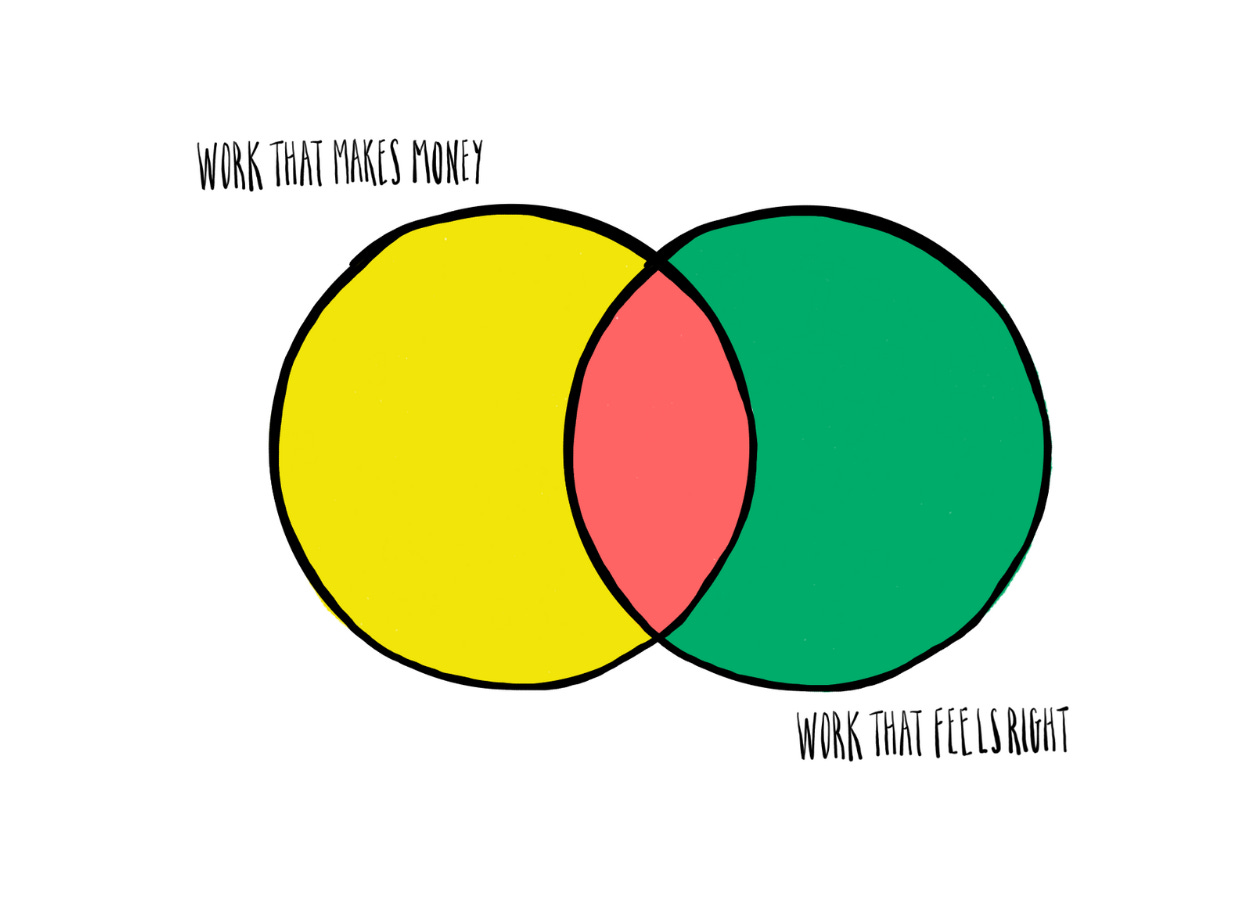
Learning to make money in a way that suits me has been about finding the overlap between what energises me and what’s commercially viable. The question lives in that overlap. My work now is to help others explore that overlap for themselves.
For me, The Happy Startup School is the answer I’ve arrived at. I love helping people find theirs.
When it comes to profitability, the most important metric isn’t a number. It’s a feeling. A feeling of enoughness.
But that raises deeper questions: what is enough? And how do we stop getting in our own way when we’re trying to earn it?
For me, that’s meant confronting my money stories. Money used to represent safety and achievement. I believed clever people made money and stupid people didn’t — deeply judgemental stories rooted in scarcity and competition. Business felt like winning or losing.
The more I’ve learned to notice and manage those beliefs, the better my relationship with money has become. I want to be pragmatic. I don’t want to be driven by fear. Managing money isn’t just about spreadsheets and savings — it’s about how we respond emotionally when money is involved.
I don’t want to get in my own way when asking for or spending money.
I’ve learned that I carry my stories with me.
I just don’t want them to be the ones in charge anymore.
My story of change
I used to think I was searching for the right idea. The right purpose.
What I was really searching for was the right relationship — with work, with money, with people, with myself.
That relationship is still evolving. It always will be.
But it no longer feels like a fight.
I don’t have all the answers.
I just have better questions now.
And a deeper trust that when the work fits, it doesn’t need forcing.
It has its own effortless momentum.