


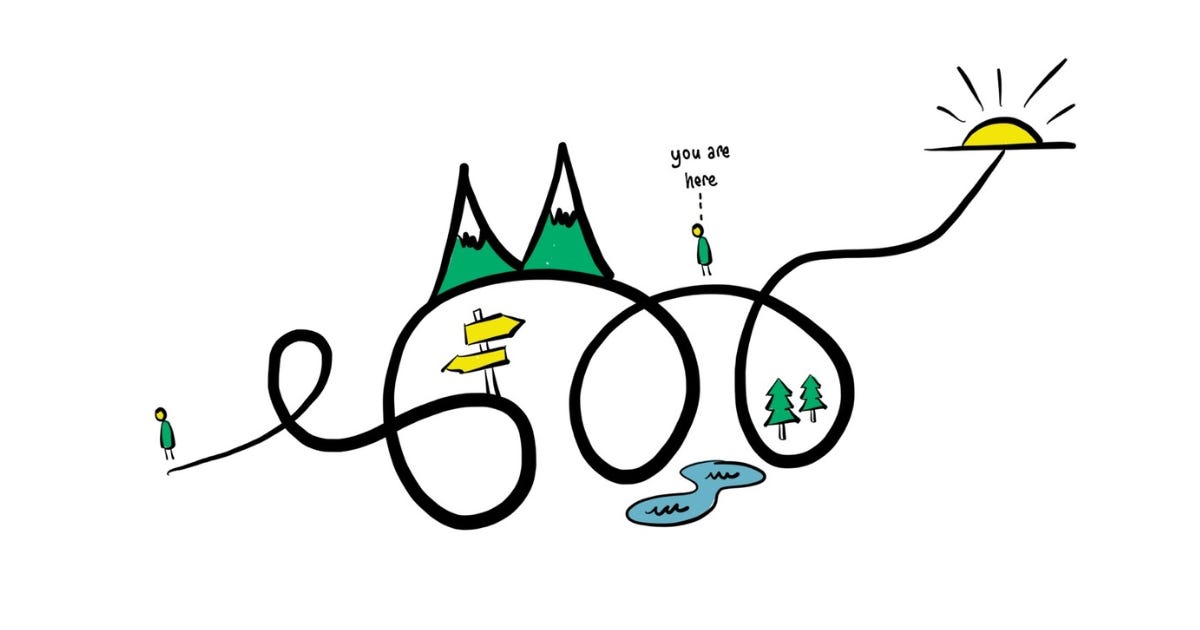
There’s a particular kind of tiredness that comes from feeling you should be further along.
You look around and other people seem to be making progress.
They’ve got plans. Ideas. Direction.
They seem to know what they want and where they’re going.
Meanwhile, you’re still trying to work things out.
Perhaps you’ve started something new. A course, a project, a business, or simply an attempt to figure out what you want from the next chapter of your life.
You began with good intentions.
But life got in the way.
Work. Family. Illness. The everyday demands of being human.
And now you’re looking at everything you haven’t done, feeling as though you’re falling behind.
It’s easy to turn that feeling into a judgement about yourself.
I should have figured this out by now.
I should be making more progress.
I should be further ahead.
But further ahead of what? And according to whose timeline?
The problem with progress
For much of my life, I’ve been good at achievement.
I did a PhD. Built businesses. Earned a black belt in kung fu.
I learned how to work hard, commit to something and keep going.
And those things have served me well.
But I’ve also learned that progress isn’t always about doing more, achieving more or getting somewhere faster.
Sometimes the most important changes in life are harder to measure.
Becoming more comfortable with uncertainty.
Learning when to let go.
Finding the courage to disappoint someone.
Being less concerned with proving yourself and more interested in understanding yourself.
These things don’t come with certificates.
You can’t put them on LinkedIn.
But they might be the most valuable things we learn.
What if growing older means growing deeper?
Recently, I came across an article by Cash Ahenakew called Towards Eldering.
It’s a challenging read, drawing on Indigenous knowledge and reflections about ageing, responsibility and our place in the world.
But one idea really stayed with me.
What if growing older isn’t simply about growing up, but growing down?
Like a tree, we spend so much of our early lives growing upwards.
Reaching.
Stretching.
Trying to become bigger, stronger and more visible.
We want to prove ourselves. Make our mark. Show the world what we’re capable of.
And there’s nothing inherently wrong with that.
But as we get older, perhaps a different kind of growth becomes possible.
Growing deeper roots.
Becoming more grounded in who we are.
Less dependent on other people’s approval.
More accepting of life’s contradictions.
More able to offer what we’ve learned without needing recognition in return.
Ahenakew calls this process eldering.
It’s not simply about getting old. Age doesn’t automatically make us wise.
It’s about learning to relate to ourselves, other people and the world with greater honesty, compassion, responsibility and care.
Not just asking what we can get out of life.
But what we can bring to it.
I find that a really helpful shift in perspective.
Because perhaps the second half of life isn’t about becoming more impressive.
It’s about becoming more fully ourselves, and learning how to put that self in service of something beyond us.
You’re carrying more than you think
When we start a new chapter, it’s easy to imagine we’re back at the beginning.
Especially when we’re stepping away from something familiar.
A career. An identity. A way of measuring success.
The old markers of progress no longer seem relevant, and the new ones haven’t yet appeared.
So we feel lost.
But there’s something important we often overlook.
We’re not starting from zero. We’re starting from experience.
All those years of working, learning, loving, losing, succeeding and making mistakes haven’t disappeared.
They’re part of us.
The difficult conversations we’ve had.
The relationships we’ve nurtured.
The disappointments we’ve survived.
The times we chose courage over comfort.
Even the things we regret.
They’ve all taught us something.
Not necessarily in ways we can easily articulate.
And not always in ways we’ve fully understood.
But that doesn’t mean the learning isn’t there.
Sometimes we just need the space to recognise it.
Maybe you don’t need another plan
One of the things I’ve noticed through my coaching work is how quickly we try to turn uncertainty into action.
Someone tells me they’re feeling lost or unsure about their direction.
And the temptation is to help them find a solution.
Set some goals.
Make a plan.
Take the next step.
Which can be useful.
But sometimes it feels like trying to build a house before you’ve understood the ground it’s standing on.
We rush towards what comes next without taking stock of what we’ve already lived.
We focus on the gap between where we are and where we think we should be.
And in doing so, we overlook the resources we already have.
Our experience.
Our relationships.
Our hard-won understanding of ourselves.
Our growing awareness of what matters and what doesn’t.
Perhaps before we ask where we’re going, it’s worth spending some time appreciating where we’ve come from.
Not to dwell on the past.
But to recognise what it’s given us.
A different kind of courage
Of course, recognising your experience doesn’t mean you can stop growing.
There are still things to learn.
Choices to make.
Responsibilities to honour.
And sometimes difficult changes to face.
But there’s a difference between moving forward because you feel inadequate and moving forward because something matters to you.
One is driven by the fear that you’re not enough.
The other comes from a growing sense of who you are and what you have to offer.
That second kind of movement might be slower.
Less dramatic.
More uncertain.
But it can also be more sustainable.
It allows you to experiment without needing every experiment to succeed.
To rest without treating rest as failure.
To change your mind without believing you’ve wasted your time.
To take a small step without knowing exactly where it will lead.
And perhaps that’s what courage looks like at this stage of life.
Not throwing everything away and reinventing yourself.
But trusting yourself enough to explore what might be possible.
One question to sit with
The original article on eldering contains a long list of characteristics and questions for reflection.
There’s a lot of richness there.
But I wonder if we might begin somewhere simpler.
Just one question.
What do you understand about life now that your younger self didn’t?
You don’t need to sit down for an hour with a journal.
You don’t need a profound revelation.
Maybe something comes to you while walking.
Or having a coffee.
Or talking to an old friend.
Perhaps it’s something about success.
Or friendship.
Or what really makes you happy.
Maybe it’s the realisation that something you once thought mattered enormously doesn’t matter quite so much anymore.
Whatever it is, pay attention.
Because tucked away in those realisations are clues about what matters to you now.
And perhaps how you want to live the years ahead.
You don’t need to turn those clues into a five-year plan.
Start by noticing them.
Give them some space.
And see where they lead.
Because the next chapter of your life doesn’t have to begin with becoming someone different.
It can begin with recognising the person you’ve spent a lifetime becoming.
You’re not starting from scratch. You’re starting from everything life has taught you so far.